
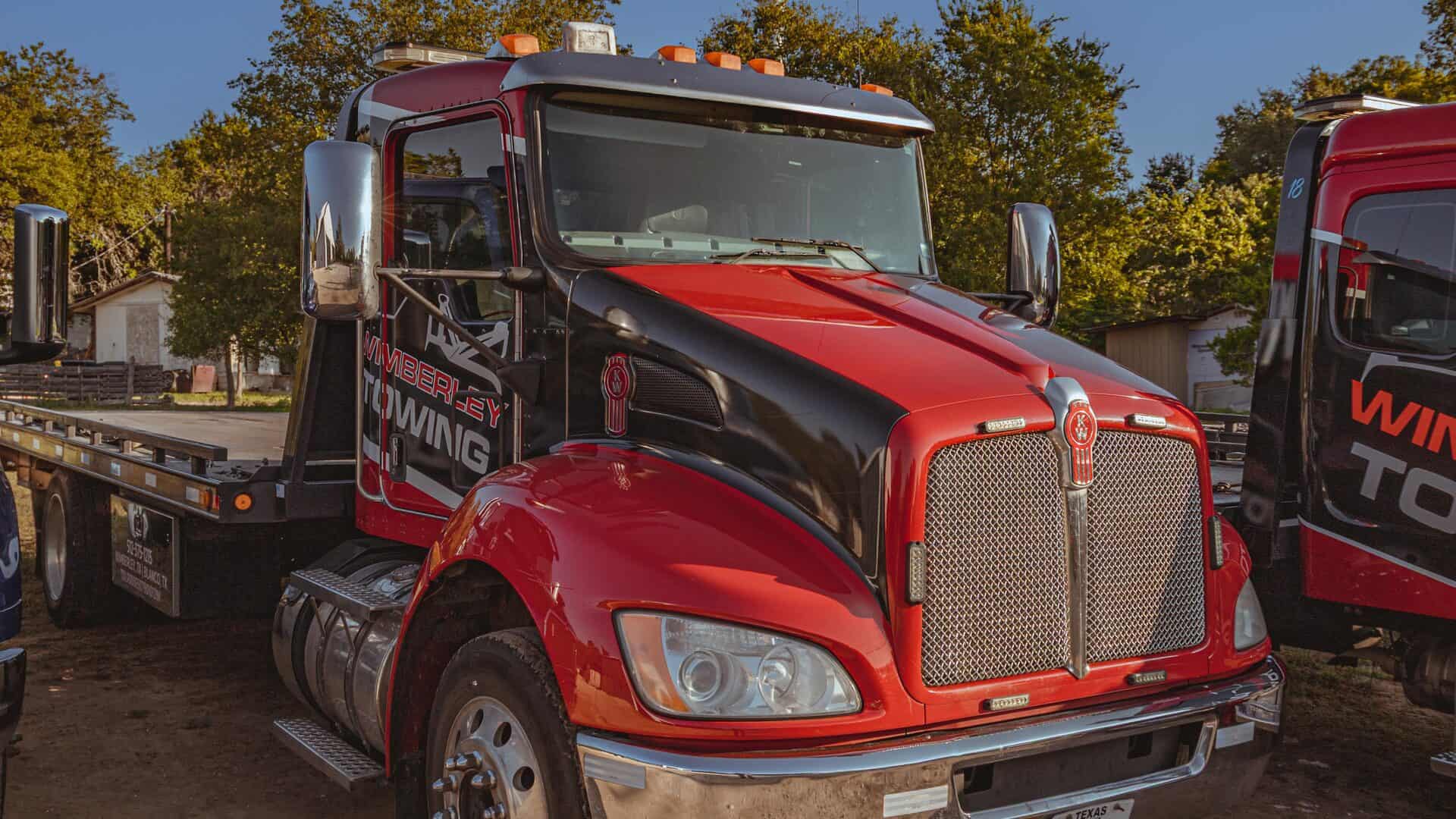
If your car was towed after a wreck or a traffic stop in Hays County, the first number you’ll hear is $272. That’s the starting rate for a police-authorized tow here. Across the county line in Blanco County, the same call starts at $300.
Towing prices in Texas aren’t a mystery, but almost nobody explains where those numbers come from. So here’s the plain version, from a company that runs the rotation.
What a tow costs in Texas, in plain numbers
Texas sets a ceiling on nonconsent towing, which are tows you didn’t ask for. The Texas Department of Licensing and Regulation publishes the caps by vehicle weight, and they apply statewide unless a city or county sets something lower.
| Vehicle weight | Statewide maximum tow fee |
|---|---|
| 10,000 lbs or less | $272 |
| 10,001 to 24,999 lbs | $380 |
| 25,000 lbs or more | $489 per unit, $978 maximum |
“Nonconsent” is the part worth understanding. It covers any tow you didn’t call for yourself. A tow after a crash, a tow ordered by a deputy, a tow off private property where you weren’t supposed to park. A tow you call yourself is a consent tow, and the caps in that table don’t govern it. That’s why two people can get towed the same day, the same distance, and see different numbers on the invoice.
Most passenger cars and half-ton pickups fall in the first row. That’s why $272 is the number most people in Hays County actually see. It isn’t a wrecker company picking a figure it likes. It’s the ceiling the state allows, published by TDLR.
Who sets the tow fee when law enforcement calls the wrecker
When a deputy or a trooper calls for a wrecker, that’s a nonconsent tow. The vehicle owner isn’t choosing the company and isn’t negotiating the rate. The county sets the rate, and the tow company charges it.
In Hays County the sheriff’s office rate starts at $272. In Blanco County it starts at $300. We run both rotations out of three yards, and we publish both numbers on our towing rates page because people ask us constantly and nobody else around here answers.
A rotation is just a list. Law enforcement keeps one, and when a wreck or a traffic stop needs a wrecker, the next company on the list gets the call. Nobody bids against anybody. The company that shows up isn’t the cheapest or the closest by definition, it’s whoever’s turn it is, working at the county’s published rate.
Here’s the part that surprises folks. The $272 that shows up on a Hays County invoice is the same figure the state lists as its light-duty maximum. So when a driver assumes the wrecker padded the bill, they’re usually looking at a state ceiling, not a markup.
What the tow fee covers, and what it doesn’t
The cap covers the tow itself. It doesn’t cover everything that can appear on the ticket. Depending on the situation, a bill can also carry:
- Storage, charged per day once the vehicle sits at a storage facility
- A one-time notification fee of $50, which covers the letters sent to the owner and any lienholder
- An impoundment fee capped at $22.85
Tow trucks aren’t interchangeable either, and that shows up in pricing. A flatbed, a wheel-lift, and a heavy wrecker are three different machines with three different jobs. Sending the wrong tow truck to a job doesn’t just cost time, it can cost a bumper.
A tow that involves winching, recovery out of a ditch, or a rollover is a different job than hooking a car in a parking lot, and it’s priced differently. On a non-police tow, we quote that up front, before the truck starts working.
Vehicle storage fees are the cost people don’t see coming
When a vehicle is towed and not released at the scene, it goes to a vehicle storage facility, or VSF. That’s the licensed lot where the vehicle sits until somebody claims it, and the storage fees are regulated separately from the tow itself. Every VSF in Texas has to be licensed, and every one has to post what it charges.
Storage is where a bill quietly grows. Texas caps daily storage at $22.85 for vehicles 25 feet or shorter and $39.99 for anything longer. That sounds small on day one. Over a long weekend, or the week it takes to sort out insurance, it isn’t small anymore.
Picture a car towed on a Friday night after a wreck on Highway 290. Nobody can reach the storage lot until Monday morning. That’s three days of storage before a single phone call gets returned, on top of the tow and the notification fee. The vehicle didn’t move an inch and the bill grew anyway.
Storage fees don’t care whose fault the wreck was and they don’t pause for the weekend. That’s the whole problem with them.
The lesson is simple and it saves real money: move fast. Every day a car sits is another line item. If you’re waiting on an adjuster, call the storage facility anyway and ask what the daily rate is and what the release process looks like.
What a tow company charges when law enforcement isn’t involved
If nobody called law enforcement, none of the rotation pricing applies. That’s a regular service call, and it should come with a number before anyone touches your vehicle.
That’s how we handle towing here. You tell dispatch where you are and what the vehicle is doing, and you get an estimate before the truck rolls. Distance matters out here. A hook on Ranch Road 12 five minutes from our Wimberley yard is a different job than a recovery on US 281 north of Blanco at midnight, and pretending otherwise would just be a way to surprise you later.
How you pay matters too. A tow company has to take cash, debit, or credit, so you shouldn’t be sent looking for an ATM at midnight. Ask what the charge will be, ask how the company takes payment, and ask whether the vehicle is going to a storage facility or straight to a shop. Those three questions cover most of what goes wrong on a bill.
Weight class matters too, and people guess it wrong more often than you’d think. A dually with a loaded trailer, a small RV, a box truck: those aren’t light-duty jobs, and sending a light-duty truck to one just means a second call and a longer wait. When you call, describe the vehicle honestly. It costs nothing and it gets the right truck on the first try.
Plenty of these calls never become tows at all. A jump start, a tire change, a lockout, or a few gallons of fuel puts most people back on the road, and roadside assistance costs a lot less than a tow and a night of storage.
What to do if you think you were overcharged
Towing in Texas is governed by Chapter 2308 of the Texas Occupations Code, and it gives vehicle owners real deadlines to work with.
- Notice. The first written notice has to go out by the fifth day the vehicle is on the lot. A second notice follows between the 15th and 20th day after the first one was mailed.
- Payment. Operators have to accept cash, debit, or credit. Cash-only is not allowed.
- A hearing. You can request a tow hearing in justice court within 14 days of the tow, and the court holds it within 21 days of filing.
Those deadlines exist because the state knows a towed vehicle puts somebody in a bad spot. You may need the car for work. The paperwork may be inside it. Fourteen days sounds generous right up until the week gets away from you, so if something on the invoice looks wrong, start early rather than waiting to see whether insurance sorts it out.
Storage facilities are also required to post their fees. If a number on your invoice isn’t posted and isn’t explained, ask for it in writing.
One more practical note. Ask for an itemized invoice every time, whether the tow was ours or somebody else’s. A line that says “towing and storage” tells you nothing. A line that separates the tow, the daily storage, the notification fee, and any recovery work tells you exactly which number to ask about.
None of this is meant to scare anybody. Most towing calls in the Hill Country are ordinary and end with a handshake. But knowing the ceiling, the deadlines, and who actually set the price puts you in a much better position on the worst day of your week.
And if you’re reading this before anything has gone wrong, the single most useful thing you can do is put a real dispatch number in your phone now. On the shoulder at night, with traffic going by, is a bad time to start searching.
If you want the current numbers in one place, they’re on our rates page, and dispatch answers 24 hours a day if you’d rather just ask a person.