What counts as heavy duty
Class 7 and Class 8 tractors, loaded trailers, box trucks above the medium duty line, motorcoaches, school buses, and the big diesel pushers people call RVs but which are really buses. The working rule is simple: if it needs air released before it moves, it is heavy duty, and a standard tow truck will not touch it safely.
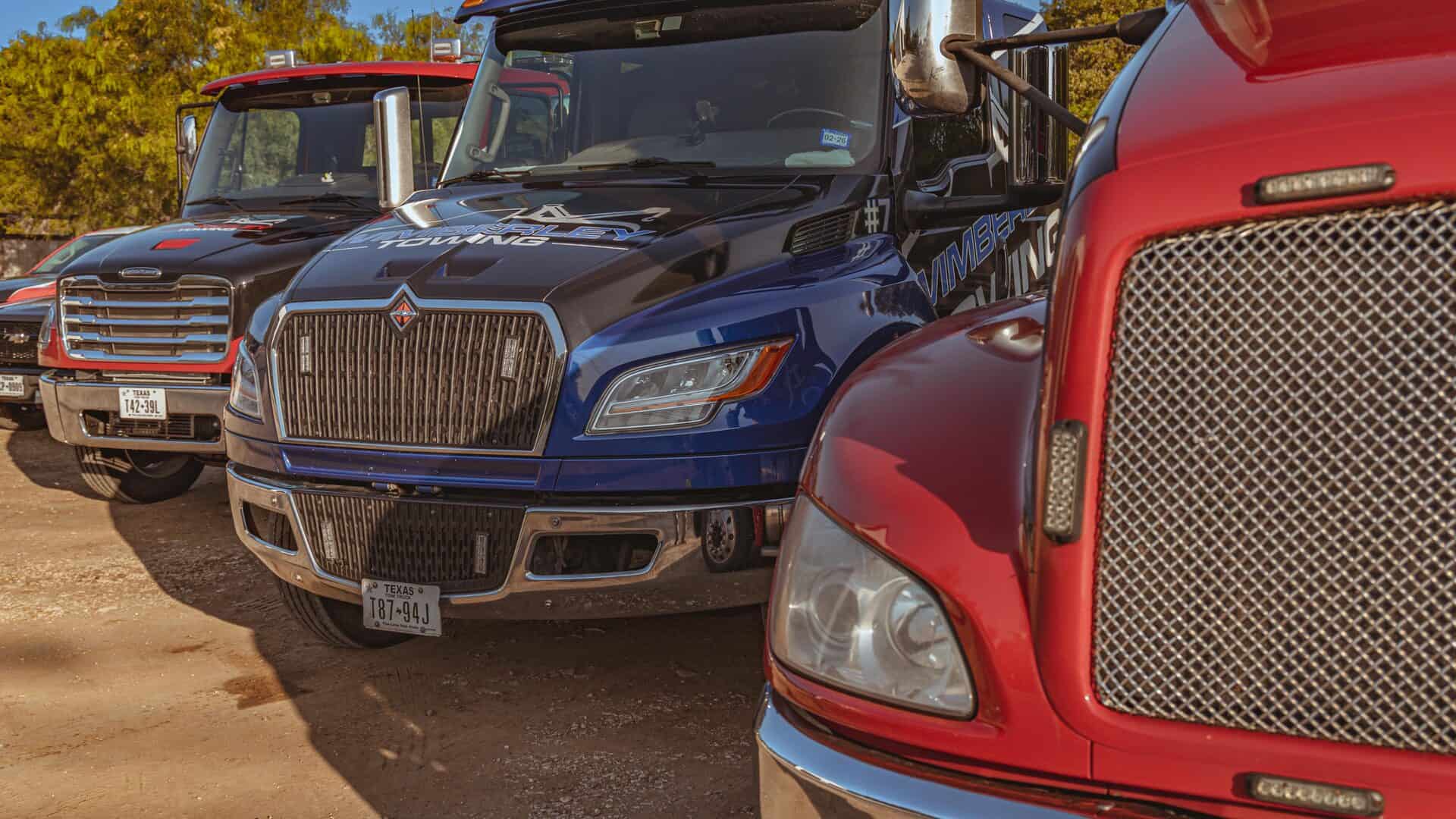
Wimberley Towing runs heavy duty towing equipment out of three Hill Country yards, in Wimberley, Kyle, and Blanco. That matters more than it sounds, because the alternative on most of these corridors is a wrecker service dispatched from San Antonio or Austin that has an hour of driving to do before it can begin helping you.
The corridors that produce the calls
Heavy duty work out here is corridor work. The roads make the calls, and each one fails vehicles in its own way.
- US 281 through Blanco County. A two lane highway doing the job of a freight route. Narrow shoulders, long gaps between exits, and grades that a loaded trailer feels. We keep a yard in Blanco specifically for this, and there is a page for heavy duty towing on US 281.
- Highway 290. The climb west out of Oak Hill toward Johnson City punishes cooling systems and brakes. See Highway 290 towing and heavy duty towing in Dripping Springs.
- I-35. The Buda to San Marcos stretch is some of the busiest interstate in Texas. A stall in a live lane there is a safety problem before it is a towing problem.
- Highway 71 and Ranch Road 12. The connectors, and where the surprises happen.
What we tow and recover
Semi trucks and tractor units, loaded and empty trailers, box trucks, dump trucks, concrete mixers, buses and motorcoaches, large RVs, and the commercial equipment that gets moved on them. If you are not sure which class your vehicle falls into, tell dispatch the make, whether it is loaded, and the approximate weight, and we will know which tow truck to send.
Why a loaded truck is a different job
Recovering a loaded truck is not the same job as towing an empty one, and the difference is where inexperience shows. Weight distribution changes what can be lifted and from where. Air systems have to be released before anything moves. The driveline may need protecting, and whether the trailer is still upright changes the entire approach.
Our drivers are WreckMaster certified, which is a recognised training standard for towing and recovery rather than a decal on a door. In practice it means you get told on the phone what the recovery actually involves, rather than everyone finding out together on the shoulder.
When it is a recovery, not a tow
If the truck has left the pavement, gone down an embankment, or the trailer has come off the road, that is a winch job before it is a towing job. It needs line, an anchor, and an angle rather than a hook, and it needs the ground assessed first. See off-road recovery.
What to tell dispatch
On a heavy call, four answers decide what equipment leaves the yard: the mile marker or nearest cross road, your direction of travel, whether the vehicle is loaded and roughly how heavy, and whether any part of it is sitting in a live lane. That last one is a safety question, not a scheduling one, and it changes how fast we come.
Running a fleet
The worst possible time to go looking for a heavy duty wrecker service is at two in the morning with a loaded trailer blocking a lane. Fleet managers, dealerships, and shops set up a corporate account with approved credit so the call is already arranged, the terms are already agreed, and dispatch already knows what you run. Talk to us before you need it.
Below the heavy line
If it is a dually, a box truck, a sprinter van, or a mid size RV, that is medium duty towing, and sending the wrong truck means you wait twice. Cars and light trucks go on a deck, which is flatbed towing. The full range is under towing services.
Call (512) 375-1215. Dispatch answers 24 hours a day.
What a heavy duty recovery actually costs
There is no honest single number, and any towing company that gives you one over the phone without asking questions is guessing. Heavy duty pricing turns on the class of equipment the job needs, how long the recovery takes, whether the load has to be transferred, and whether the road has to be closed. A straightforward tow of an empty tractor is a different job from uprighting a loaded trailer on a grade.
What we will do is tell you the number before the truck leaves the yard, and not change it on arrival. If law enforcement ordered the tow, the rate is set by the county rather than by us: $272 starting in Hays County and $300 in Blanco County. Those figures are published on our towing rates page.
Staying safe until we get there
On US 281 and Highway 290 the shoulders are narrow and the traffic is fast. If your truck is disabled and any part of it is in a live lane, that is the first thing to say when you call. Get your triangles out as far back as you safely can, keep your lights on, and get yourself behind the barrier or well off the pavement. Do not stand between your truck and oncoming traffic, and do not try to work on the rig with your back to the lane.
Most of the genuinely bad outcomes on these corridors happen to people standing beside a stopped vehicle, not to the vehicle itself.
Commercial towing and heavy equipment transport
Not every heavy-duty call is a breakdown. A good share of our commercial towing work is scheduled: moving a dead rig between yards, recovering a unit after a repossession, or transporting heavy equipment that cannot legally or safely drive itself between sites.
Heavy equipment transport is its own discipline. Weight has to sit where the deck can carry it, the load has to be secured to a standard that survives an emergency stop, and the route has to actually accommodate the height and width. Truck towing and equipment transport are related jobs but they are not the same job, and dispatch will ask which one you have.
If you run commercial vehicles regularly, a corporate account covers both, with agreed terms rather than a roadside negotiation.
Heavy-duty towing service, and what to expect on arrival
The truck arrives, the driver assesses before he touches anything, and he tells you the plan. That is what a heavy-duty towing service should look like, and it is what WreckMaster certification is actually for. What you should not get is somebody hooking a chain on and finding out.
If the recovery turns out to be different from what you described on the phone, we will tell you that before the price changes rather than after. Heavy work has genuine variables in it, and pretending otherwise is how customers end up furious at a roadside.